Why These Deep Channels of Qi Matter for Treatment and Life
In classical Chinese medicine the Eight Extraordinary Vessels are the deepest currents of qi in the body. They arise from Kidney jing, hold our ancestral blueprint, and regulate how our life unfolds through time.
The ordinary twelve channels manage daily functions: digestion, respiration, movement, immunity. The extraordinary vessels are different. They are slower to change, but when they are disturbed, the effects can shape a whole lifetime.
Contemporary classical teachers such as Jeffrey C. Yuen, Giovanni Maciocia, and Anne Cecil Sterman describe these vessels as:
- reservoirs of qi and blood
- channels of destiny, shock, and deep memory
- pathways by which we can address congenital and long-standing patterns, not just surface symptoms
A helpful way to understand them clinically is through the idea of the Three Ancestries:
1. First Ancestry – “Who am I?”
2. Second Ancestry – “Where am I going?”
3. Third Ancestry – “How am I getting there, and who is in charge?”
Each ancestry is expressed through a specific group of extraordinary vessels and a set of core life questions that appear in the notes on your diagrams:
Am I comfortable with my identity?
Do I feel good about what I am doing?
Have I taken responsibility for my life?
Am I in harmony with myself and the world?
1. What makes the Extraordinary Vessels “extraordinary”?
Classical descriptions and modern commentators agree on several distinctive features.
Origin in Kidney jing.
They arise from our deepest essence, linking prenatal inheritance with postnatal life.
Reservoirs for qi and blood.
They store surplus and supplement the primary channels when demand is high or when long-term depletion has occurred.
Regulation of the “seas.”
They govern the seas of qi, blood, marrow, yin, and yang, and so influence the whole economy of the bodymind.
Vessels of destiny, trauma, and latency.
They carry how we have met major transitions and shocks, and how unresolved experiences are stored.
Because of this, the extraordinary vessels are central when working with constitutional and inherited conditions, complex multi-system chronic disease, trauma and shock (physical, emotional, spiritual), developmental crises and major life transitions, and the long-arc questions of meaning and purpose.
2. First Ancestry – “Who am I?”
Chong Mai, Ren Mai, Du Mai
Your first set of notes frames this level with the question: “Who am I?” Here we are working with the prenatal blueprint and the basic formation of a self.
First Ancestry overview: Chong, Ren and Du Mai with guiding questions about identity and potential.
Chong Mai – The Vital / Penetrating Vessel
Your notes describe Chong Mai as:
- prenatal blueprint
- our potential
- allows jing to get out and be our life
- gives birth to the Sea of Yang and Sea of Yin (qi and blood)
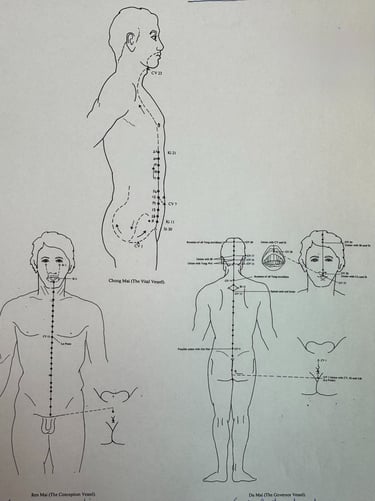
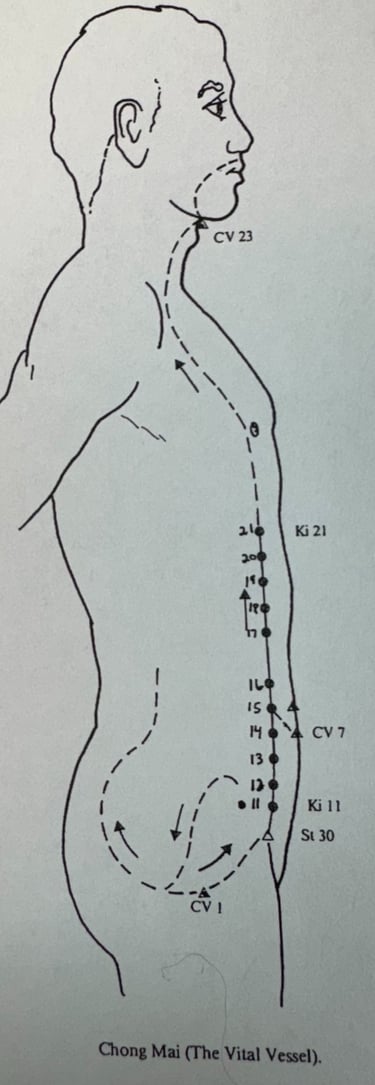
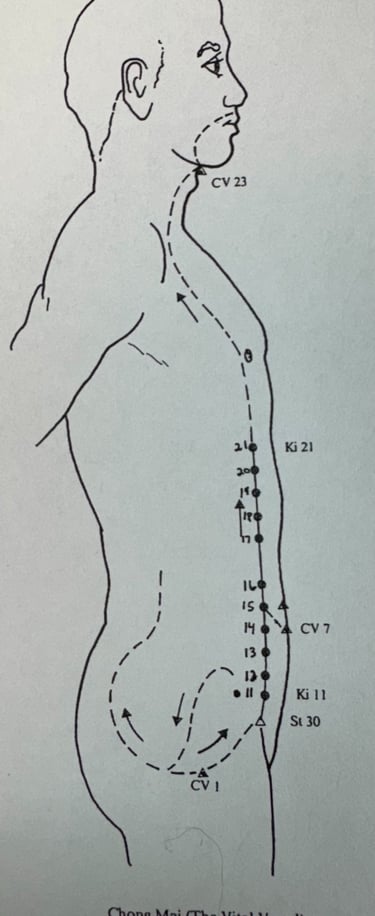
Chong Mai rises from the uterus or lower abdomen and branches through the chest, spine, and legs. It is called the Sea of Blood and the Sea of the Twelve Channels.
Chong qi sets the template for basic physiology (how the organs and channels are laid out), constitutional strengths and vulnerabilities, and deep emotional themes that feel older than this lifetime.
When Chong Mai is disturbed we may see pervasive, often non-specific anxiety, menstrual and fertility issues with a constitutional feel, profound ambivalence about being alive or incarnated, and repeating life themes that do not respond to surface treatment.
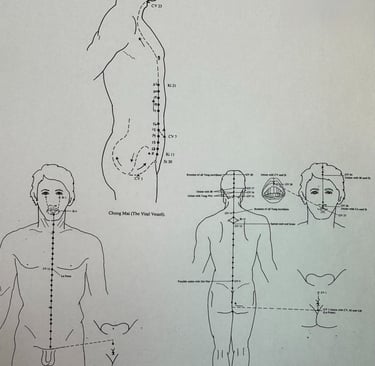
Chong Mai (side view): penetration of prenatal jing through the core of the body.
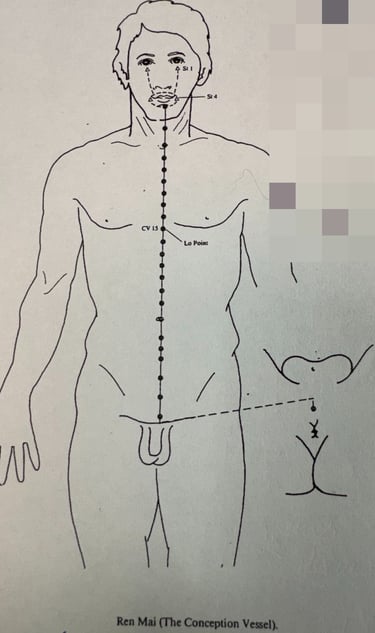
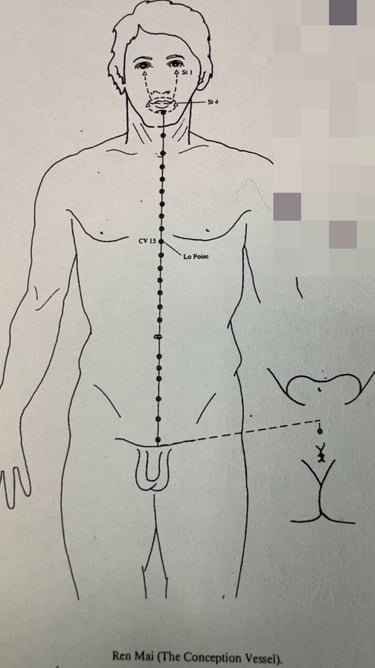
“Ren Mai (Conception Vessel): the yin ancestry of connection and bonding.
Ren Mai – The Conception Vessel (Yin; connection)
Ren Mai runs along the front midline, nourishing the yin of the whole body and governing the uterus, chest, and throat.
It is associated with bonding and attachment, our capacity to receive nourishment and support, and the ability to feel held—by family, partners, community, and our own inner “mothering.”
Disturbance in Ren qi may manifest as difficulty receiving love or help, feelings of emptiness in the chest and lower abdomen, gynecological and fertility disorders, and a longing for connection coupled with fear of intimacy.
Ren Mai (Conception Vessel): the yin ancestry of connection and bonding.
Du Mai – The Governor Vessel (Yang; independence)
Opposite Ren, your note says: “(Yang) about independence.”
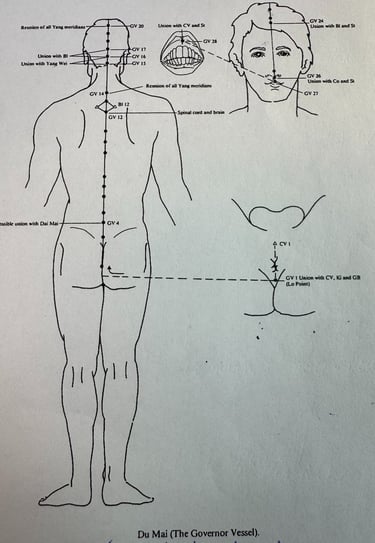
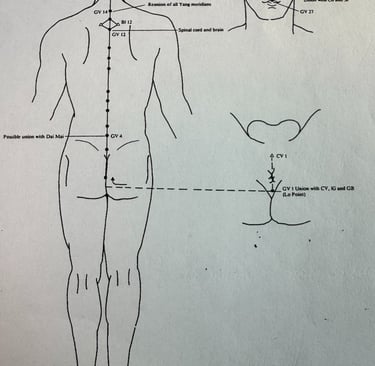
Du Mai travels up the spine and over the head, governing all yang channels and the nervous system.
It supports upright posture and structural integrity, a sense of personal agency and self-definition, and the ability to stand up for ourselves and move forward.
When Du qi is weak or disturbed we may see collapse in posture, chronic back issues, or spinal pain, timidity and lack of confidence, or dependence on others to decide, as well as agitation of the mind, rigidity, or manic states.
Du Mai (Governor Vessel): the yang ancestry of independence, posture, and the spine–brain axis.
Clinical focus of the First Ancestry
The First Ancestry answers: “Who am I?” It is engaged when there are issues of basic identity and belonging, constitutional weakness, congenital disease, early trauma, or difficulty feeling at home in one’s own body.
Working with Chong, Ren, and Du allows treatment at the level of the prenatal blueprint—how qi chose to incarnate and how it is supported or obstructed in becoming a person.
3. Second Ancestry – “Where am I going?”
Yin Wei Mai and Yang Wei Mai
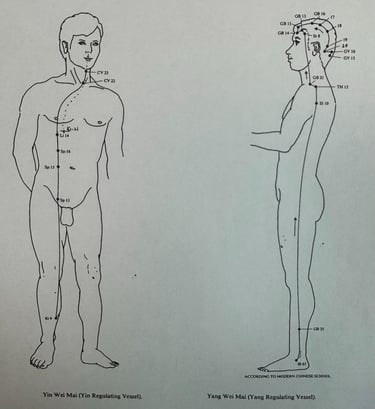
Second Ancestry: Where am I going? Control: growth, maturity, cycles of 7 and 8.”
These vessels link past and future into a continuum. In your notes:
- Wei channels = dots unfolding to reveal our lives
- link past and future into a continuum
- Yin Wei Mai: like series of photos, what did I look like
- Yang Wei Mai: what was I doing at these times in my life
- key questions: “Am I comfortable with my identity?” and “Do I feel good with what I’m doing?”
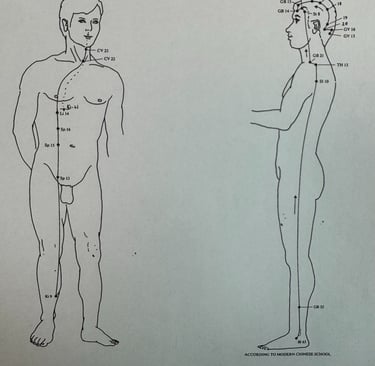
Second Ancestry overview: Yin and Yang Wei Mai showing how dots of experience unfold through life.
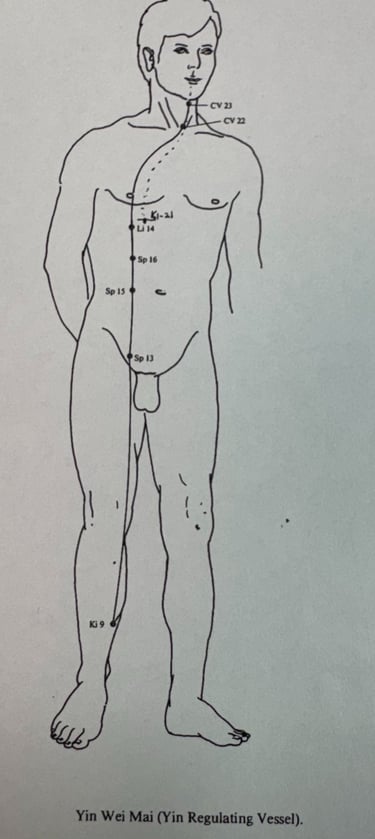
Yin Wei Mai – Inner story through time
Yin Wei Mai connects the yin channels and the chest. It is strongly related to the Heart, Pericardium, and Kidney.
It stores the inner meaning of events, helps integrate emotional experiences into a coherent story, and governs the maturation of the emotional body.
Clinical signs of disturbance include feeling stuck in an earlier era of life, chronic sadness or heartbreak that never moves on, depression, loss of inner continuity, or a sense that one’s life story does not make sense.
Yin Wei Mai (Yin Regulating Vessel): continuity of our inner story and emotional life.
Yang Wei Mai – Outer roles and activities
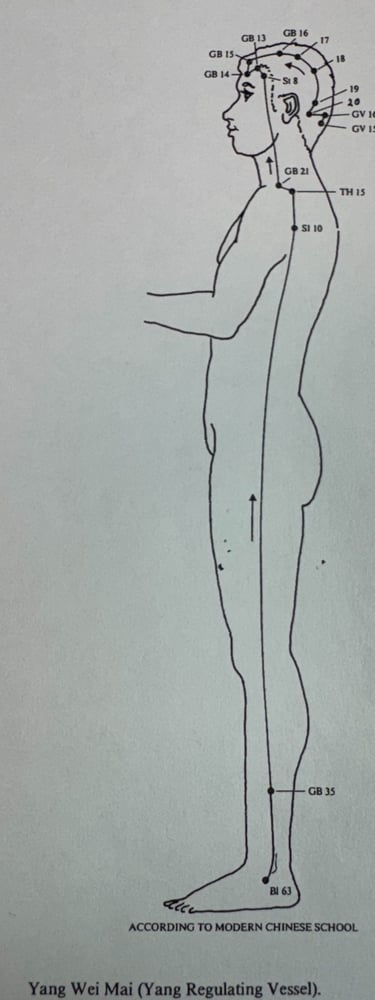
Yang Wei Mai runs along the lateral body and head, linking the yang channels.
It organizes our outer engagements and roles, sequences life events such as jobs, projects, and responsibilities, and helps us adjust our activity appropriately to each life phase.
Disturbance can manifest as chronic overdoing or burnout, inability to leave outdated roles or situations, or a mismatch between inner calling and outer life.
Yang Wei Mai (Yang Regulating Vessel): how our outer life and roles unfold through time.
Clinical focus of the Second Ancestry
The Second Ancestry answers: “Where am I going?” It is particularly important for major life transitions (puberty, leaving home, mid-life, menopause or andropause, aging), feeling stuck in the past or unable to imagine a future, and difficulties harmonizing male/female identity and maturity.
Treatment at this level helps a person feel that their life has a meaningful trajectory rather than a collection of disconnected episodes.
4. Third Ancestry – “How am I getting there, and who is in charge?”
Yin Qiao Mai, Yang Qiao Mai, Dai Mai
Your third sheet is titled: “Third Ancestry: How am I getting there? Who’s in charge?” with the note “Have I taken responsibility for my life?”
It also includes reflective questions:
Am I happy with what I am?
Am I happy with self?
Am I happy with what I’m doing?
Am I in harmony with world?
This level governs posture, gait, and the immediate way we step into situations—how the past and our blueprint are expressed in the present moment.
Third Ancestry overview: Yin Qiao, Yang Qiao and Dai Mai with questions about happiness, responsibility and harmony.
Yin Qiao Mai – Inner stance
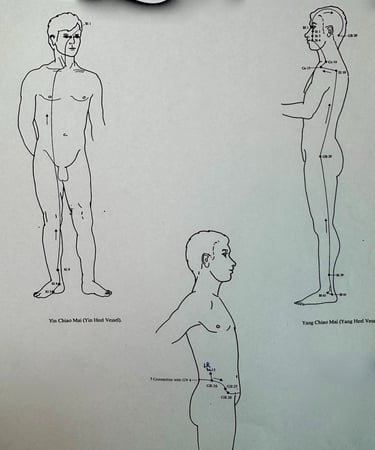
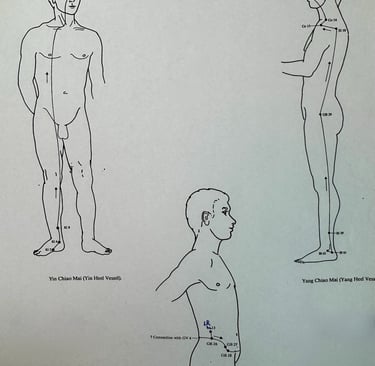
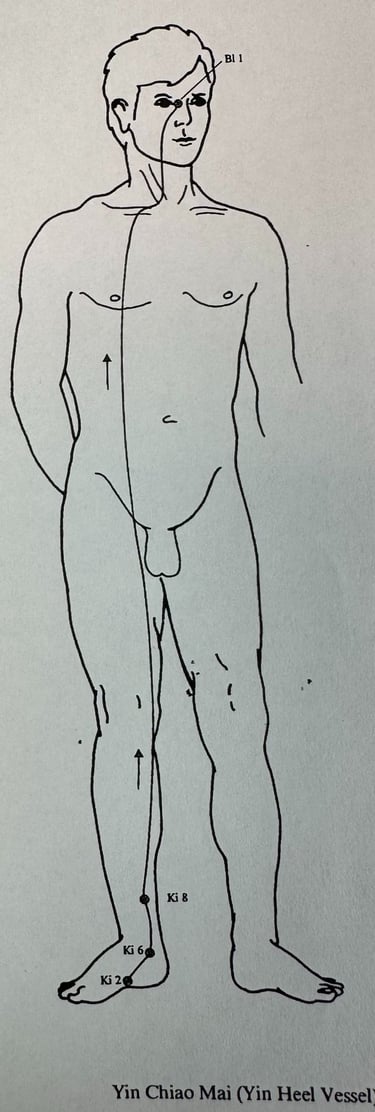
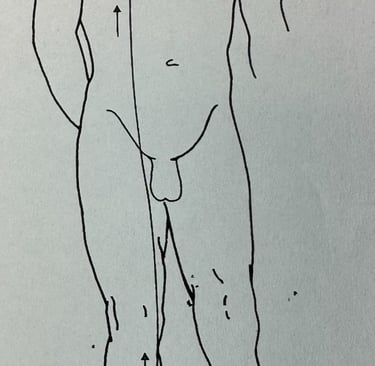
Yin Qiao Mai (Yin Heel or Motility Vessel) runs along the inner leg and torso and connects to the eyes.
It governs our inner stance toward ourselves, helps regulate sleep (especially the ability to stay asleep), and influences our capacity for intimacy and self-reflection.
Disturbance may present as insomnia and restlessness at night, withdrawal, collapse or over-internalization, and difficulty allowing oneself to be seen or to stand in one’s own value.
Yin Qiao Mai (Yin Heel Vessel): how we stand in relation to ourselves and to rest.
Yang Qiao Mai – Outer stance
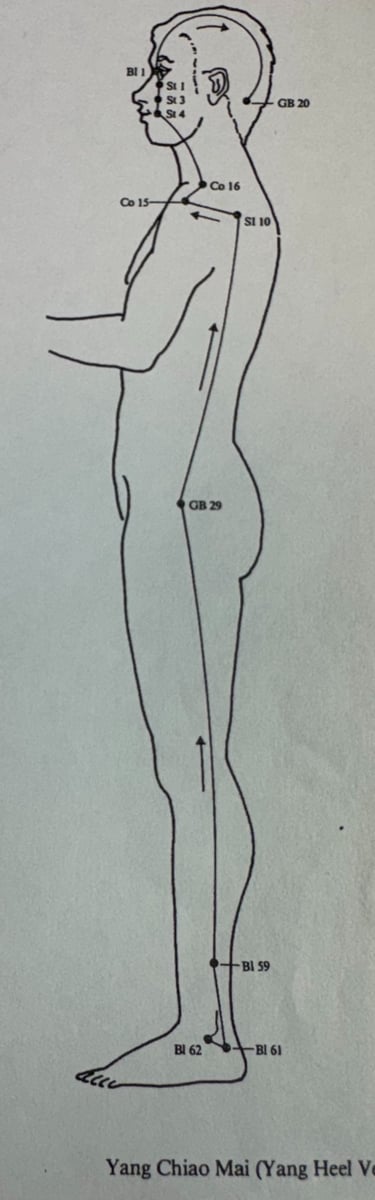
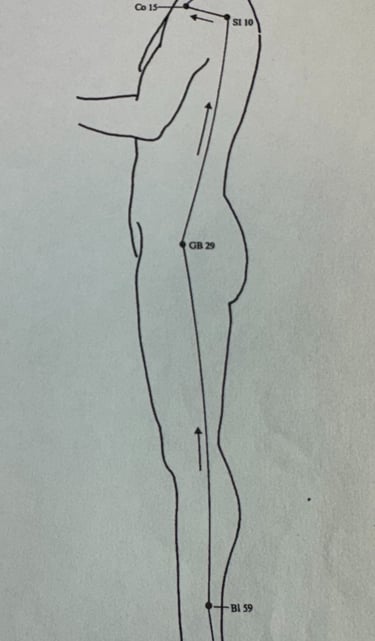
Yang Qiao Mai (Yang Heel or Motility Vessel) runs along the outer leg and side of the body, also reaching the eyes.
It governs our outer stance in the world, regulates quick responses and defensive postures, and supports the ability to step up and act.
Disturbance may show as hyperactivity, impulsivity, or chronic vigilance, rigid posture or attitude, and difficulty relaxing into receptivity, always needing to be “on.”
Yang Qiao Mai (Yang Heel Vessel): how we step forward and protect ourselves in the world.
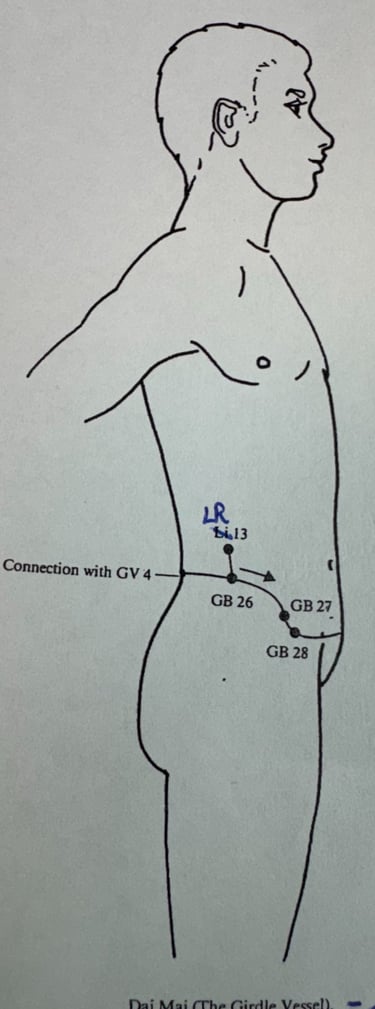
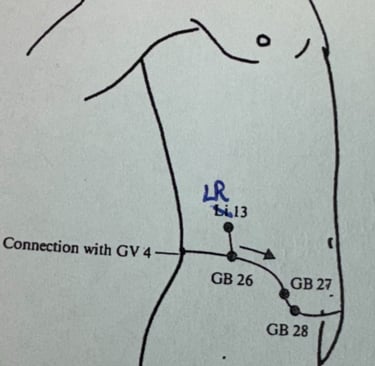
Dai Mai – The Girdling Vessel
Dai Mai encircles the waist like a belt, binding all the vertical channels. Your note at the bottom of the page describes it as “store old stuff” and “holds on to too much or not enough.”
It collects what cannot move up or down and holds it in latency, defines boundaries—what we carry and what we leave behind—and relates to issues at the waist, hips, and lower abdomen.
Disturbance can appear as a feeling of being bound or stuck in old patterns, alternating excess and deficiency around the middle (weight, tension, weakness), and going in circles in relationships or life situations.
Dai Mai (Girdle Vessel): storage and release of old patterns around the waist and hips.
Clinical focus of the Third Ancestry
The Third Ancestry answers: “How am I getting there?” and “Who is in charge?” and “Have I taken responsibility for my life?”
It is activated when posture, gait, and facial expression clearly mirror emotional patterns, when a person repeatedly acts in ways they consciously do not choose, and when boundaries, intimacy, and present-time responsiveness are central issues.
Working with the Qiao and Dai vessels helps bring the inherited blueprint and life story into conscious choice in the present moment.
5. Why the Extraordinary Vessels are central for treatment and life support
Without the extraordinary vessels we treat only the branches of disease, not the roots.
They hold the ancestral template.
Chong, Ren, and Du express the prenatal blueprint: identity, connection, and independence. Treating them allows work with congenital, early-life, and trans-generational patterns.
They organize the life story.
Yin and Yang Wei link the “photos” and “events” of our life into a continuum. This is crucial for trauma, developmental arrest, and major transitions.
They govern our stance in the present.
Yin and Yang Qiao, with Dai Mai, show whether we are actually living our destiny—how we stand, move, and respond now.
They bridge body, mind, and spirit.
These vessels explain why long-term emotional climates (anger, worry, fear, sadness, shame) eventually manifest physically: they alter the deep circulation of qi and blood over years and decades.
They support cultivation, not just symptom relief.
Extraordinary-vessel work can align qigong, meditation, and life choices with the original intention of the spirit.
6. Bringing this into clinical and personal practice
In treatment, extraordinary-vessel protocols may include:
- opening and coupled points for the appropriate vessel pair
- needling sequences based on a person’s ancestry theme and life questions
- integrating bodywork, breathing, and awareness around the midline, spine, and gait
For patients and students, the three ancestries can be used as living inquiries:
First Ancestry:
Who am I? Am I comfortable with my identity? Do I feel at home in my body?
Second Ancestry:
Where am I going? Do I feel good about what I am doing? Does my life story feel coherent?
Third Ancestry:
How am I getting there? Who is in charge of my choices? Am I in harmony with myself and with the world?
The extraordinary vessels give structure to these questions inside the body. By working at this level—through acupuncture, qigong, breath work, and conscious inquiry—we are not only treating disease. We are supporting the entire trajectory of a human life, from inherited blueprint, through unfolding destiny, into present-moment responsibility.
The Three Ancestries and the Eight Extraordinary Vessels